Curating sound
How music has shaped Hale Library
By Ashley Nietfeld
Libraries, like our homes, are shaped by those who inhabit them. Patrons, researchers, students and librarians all leave an imprint — books checked out remain in circulation, interlibrary loan requests lead to new purchases and the interests of libraries’ stewards, the librarians, shape the direction of a collection’s growth.
In this way, Hale Library has become a connection point for the musical arts.
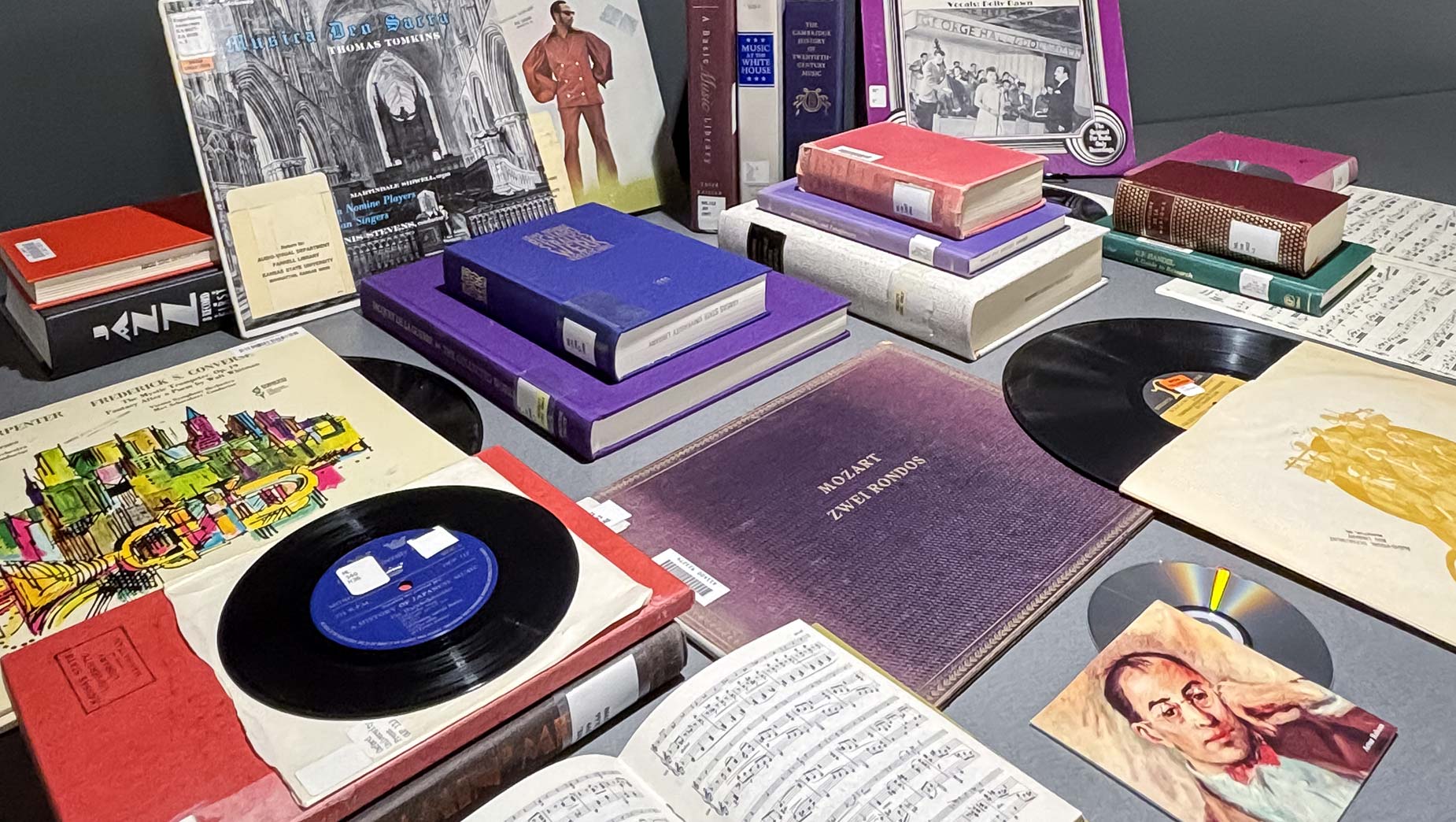
Like many academic libraries, K-State Libraries maintains a curated music collection that includes printed scores, video and audio recordings of performances, scholarly editions of musical scores and performance editions marked with suggestions from editors. And of course, there are also books about music — history, musicology, composer biographies, pedagogy and more.
“The music collection at Hale Library serves a vast array of purposes,” said Craig B. Parker, associate professor of music history at K-State. “Its musical scores, recordings, DVDs and online databases are regularly used in music classrooms and studios. The collection also serves as primary source material for student research papers and faculty publications.”
Librarians work closely with university faculty to choose materials that support new courses and evolving curricula and research interests, adding resources on different composers and genres as needed.
But a collection is also shaped by other factors.
Building a collection
“Our priority, as a library, is to support the teaching, learning and research of our faculty and students,” said Thomas Bell, an academic services librarian who specializes in music. “But also building collections that we think will be valuable over the long haul. Things that, over time, prove their importance; that will still be of high quality; and have been impactful in their time, affecting the music that happened after them.”
In recent years, this has led to a focus on underrepresented artists, including female, Asian and African American composers, as well as indie, hip-hop and Indigenous American music and musicians.
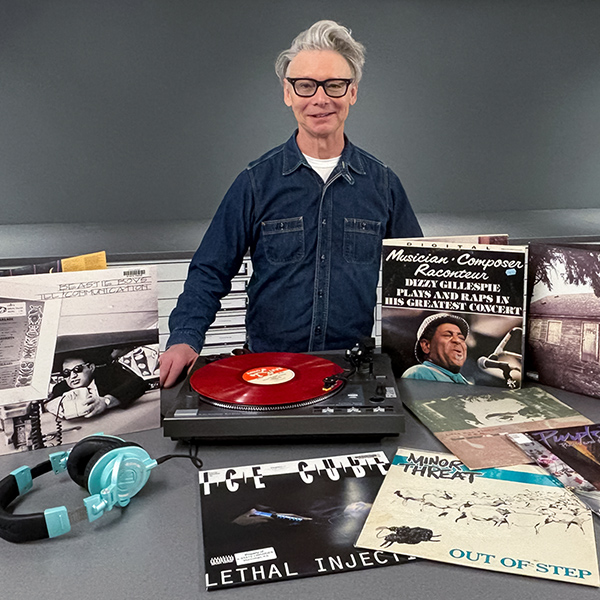
Bell has been collaborating with George Gottschalk, department head of acquisitions and resource management at K-State Libraries, as well as music librarians at the University of Denver and the University of Kentucky, to create an online discography of 21st-century Indigenous music recordings from the U.S. and Canada.
The discography will be available for use by anyone, including other libraries and educational institutions.
“Global music has become more important to curriculum in the last decade or so, and we’ve made an effort to collect as much as we’ve been able to from non-Western sources, but including Indigenous American music,” said Bell. “We’re seeking to be respectful of the music, the intended purposes of the music and the rights of the creators.”
Another unique aspect of K-State Libraries’ music collection is its 90-volume set of “Heritage of the March,” a collection of 185 vinyl records of nearly 3,000 marches and galops. The records were produced in small runs of between 600 and 3,000 and were never made for sale to the public.
“The cool thing about this collection is it’s not available digitally at the moment, like a lot of LPs,” said Bell. “And, of course, there are liner notes with all those, so that’s an important starting place for composers who are lesser known that have just not been written about as much. That’s part of the rationale for holding on to our vinyl collection is just there’s valuable information in those liner notes.”
There’s a song? About Hale?
With Bell focused on shaping the Libraries’ physical and digital collections, K-State Libraries’ associate dean Laurel Littrell has been inspired to move in a different direction.
In 2022, she was chatting with Parker when he asked if she would be willing to compose a new piece for the Hale Library Concert Series. Littrell is a former music student of Parker’s and a regular attendee of the annual concerts organized by the Friends of the K-State Libraries.
She was working at Hale Library when a fire in May 2018 destroyed a portion of the building, requiring a nearly four-year restoration project. When she considered the subject of her composition, that’s what came to mind.
“The themes in 'Hale! Hale! Hale!' include celebration, inspiration and the familiar alma mater,” said Littrell. “The second movement portrays the sadness and despair using the brass instruments to depict fire alarms and sirens. From this grows a triumphant melody meant to propel us forward.”
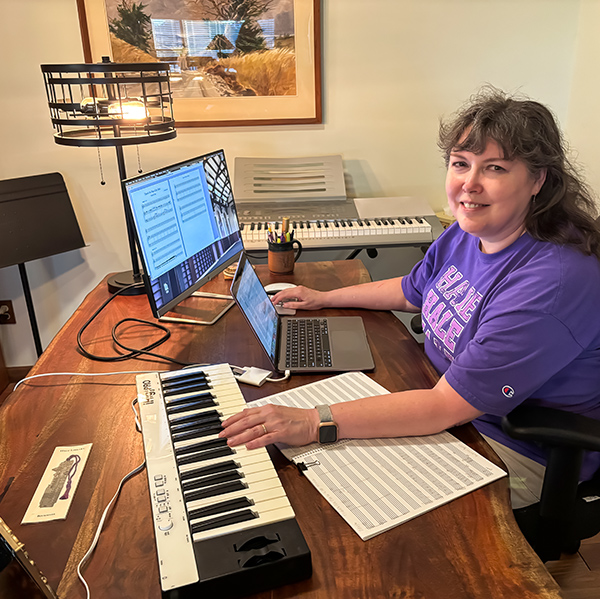
"Hale! Hale! Hale!" premiered at the Hale Library Concert Series in November 2022 and was performed by the K-State Faculty Brass Quintet. The song title is a play on words of the K-State Alma Mater, composed by H.W. Jones in 1888.
Littrell is currently working on a new piece of music for the centennial celebration of Farrell Library in 2027. Farrell was the first building at K-State to house only library collections. Three structural additions were made in the subsequent years and it was renamed Hale Library in 1997.
“Farrell Library has been part of so many lives for nearly a century,” said Littrell. “It’s a way to honor the library’s history and say thank you."
Live in concert
The idea for the Hale Library Concert Series was sparked in 2003 after the Friends of the K-State Libraries Board was approached about the purchase of a seven-foot Mason & Hamlin grand piano. An unusual request, perhaps, but the vote was unanimous. Under the leadership of Mary Ellen Titus, the president of the board at the time, the piano underwent restoration and plans for an annual series began to form.
“No one has done more for music in Manhattan than Dr. Titus,” said Parker. “She has been a lifelong supporter of music at K-State, founded the Young People's Concerts for local elementary school students and enabled regular Suzuki violin instruction for everyone in her own Roosevelt School classrooms and at the Manhattan Arts Center.”
The first performance of the Hale Library Concert Series occurred on Feb. 3, 2006, and featured the former director of keyboard studies at K-State, Robert Edwards, and his successor, Sławomir Dobrzański.
Titus continued to shepherd the project, along with Parker and (later) fellow board member Nancy Raleigh, until she retired from her co-chair role in 2023. Today, Parker serves as the chair and organizes the performances.
The series has maintained its original composition of four performances each academic year featuring artists from K-State and around the world. The final performance each year, Jazz in June, is a particular favorite and sells out early.
“I envision the Hale Library Concert Series as another outreach service for the library,” said Parker. “It exposes the community to the library and demonstrates the incredible musicianship of K-State music faculty and alumni.”